


Travel Security · VOST Insights
How to travel safely:
15 practical tips for a safer trip abroad
Safe travel starts before departure. A practical framework for preparation, documents, transport, hotels, digital security, money, health and contingency planning.
Introduction
Most travel problems are not caused by one dramatic event. They start with something much smaller: poor preparation, bad information, an avoidable mistake, a missed warning, a lost document, an unreliable transfer, or a plan that depends entirely on everything going right.
Travel security is not about expecting the worst. It is about being prepared when the unexpected happens.
The VOST travel security framework
Good travel security is mostly invisible. It is the preparation you make before anyone notices there is a problem.
01
Information
Know the destination before it surprises you.
02
Preparation
Decide the first hour before you land.
03
Awareness
Notice change early, without living in alert.
04
Contingency
Have an alternative already chosen.
05
Discipline
Protect information as carefully as belongings.
06
Adaptability
Change the plan when conditions change.
01
Research the Destination Before You Travel
Hotels, restaurants and attractions are the easy part. Professional preparation looks at the environment you will actually be moving through — and accepts that a destination can change quickly.
- Local security environment and areas to avoid
- Political situation and current travel advisories
- Transport conditions and reliability
- Local laws and cultural norms
- Health risks, weather and natural hazards
- Emergency services, local emergency numbers and network coverage
French travellers should check France Diplomatie's Conseils aux voyageurs before departure, and register with Fil d'Ariane to receive alerts during the trip.
02
Plan Your Arrival Before You Land
The first hour in an unfamiliar country is usually the moment you are least informed and most dependent on other people. That hour should be decided before departure, not in the arrivals hall.
- Where you are staying, and the address written down
- How you are getting there, and roughly how long it should take
- Who is collecting you, and what legitimate transport looks like
- What you do if the planned transport does not appear
- Who to contact if the plan changes
For higher-risk destinations, use professional or vetted transportation rather than improvising at the airport.
03
What Should You Carry in Your Travel Bag?
A useful travel bag is small, practical and legal. Redundancy matters more than volume: two ways to pay, two ways to prove who you are, two ways to stay contactable.
Small, useful, redundant. Carrying too much equipment becomes its own problem.
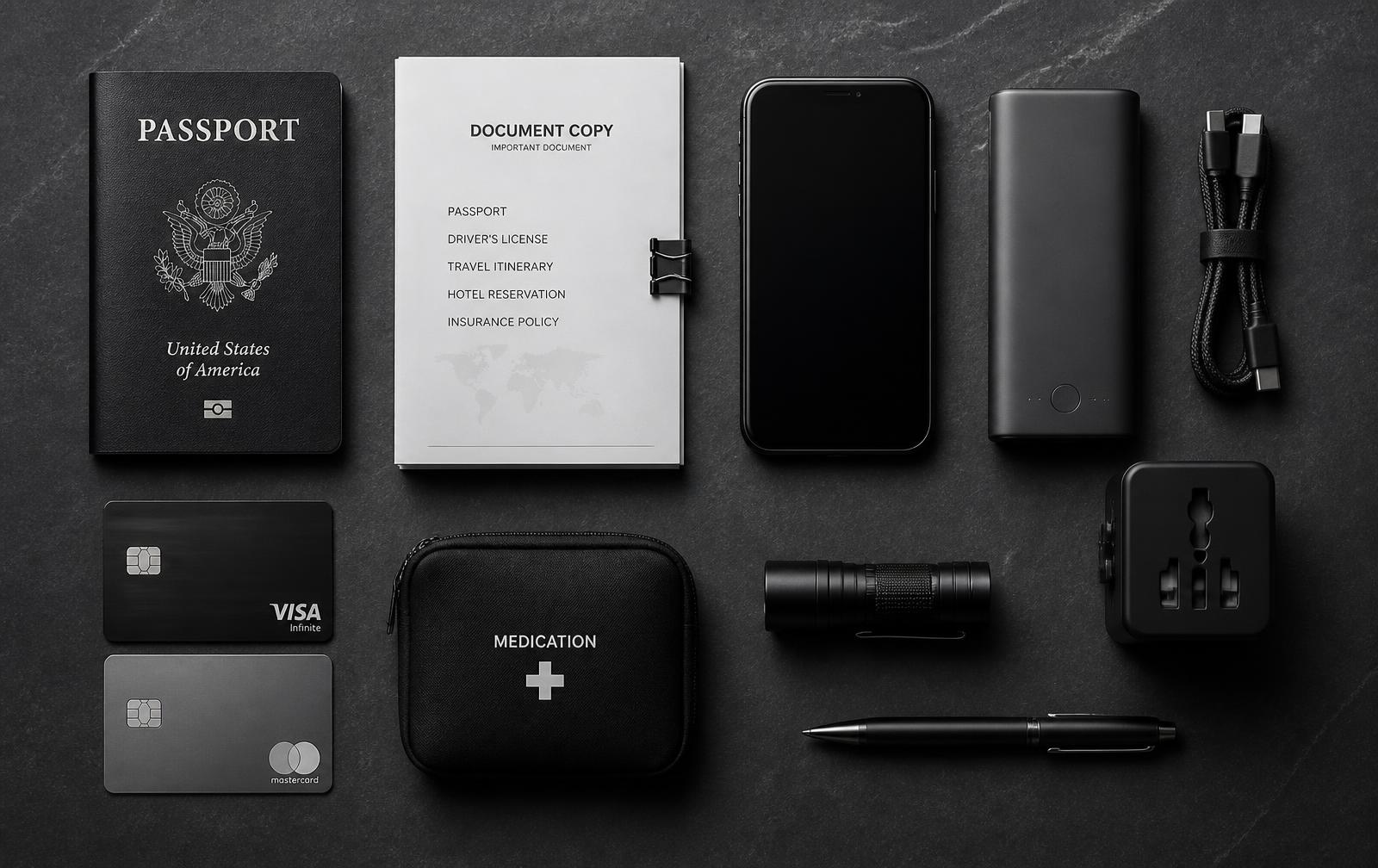
What should I put in my travel bag?
Documents
- Passport
- Visa / entry documents
- Insurance details
- Copies
- Emergency contacts
Communication
- Charged phone
- Charging cable
- Power bank
- Travel adapter
Finance
- Primary card
- Backup card
- Local currency
- Emergency reserve
Health
- Essential medication
- Basic first aid
- Medical documentation
Practical
- Water
- Pen
- Small flashlight
- Appropriate clothing
Pack for the destination, not for an imaginary emergency.
04
Don't Put All Your Eggs in One Basket
If one bag, one pocket or one wallet disappears, you should still be able to identify yourself, pay, communicate and reach the information you need. Never keep all your money, all your cards, all your documents and all your communication capability in the same place.
Primary, backup, recovery — kept in three different places.
Primary
What you use every day.
Backup
Kept somewhere the primary is not.
Recovery
What lets you rebuild the rest.
05
Protect Your Passport and Critical Documents
Your passport is not simply an identity document. It is your ability to continue your journey and return home.
- Keep it secured, and carry it only when necessary
- Keep a physical copy stored separately from the original
- Maintain secure digital copies you can reach offline
- Keep embassy, insurer and emergency contacts accessible
- Know the loss or theft procedure before you need it
Official French guidance also recommends keeping copies separately and having digital copies available.
06
Your Phone Is Part of Your Security
Your phone holds your identity, communications, travel documents, banking, location, contacts and accounts. Losing it is rarely just an inconvenience.
- Update the device and use a strong screen lock
- Enable device tracking and remote lock or wipe
- Back up important information before departure
- Keep sensitive information off the device where possible
- Be cautious with unknown charging points and data connections
- Use trusted networks and connections
Your phone is not just a convenience. It is part of your contingency plan.
07
Know Where You Are Going Before You Start Moving
One of the simplest ways to reduce problems is to avoid making every decision while standing in an unfamiliar place. Decide the destination, the route, the approximate travel time and the arrival point before you leave. Then move calmly and naturally, without constantly reading a map in public.
08
Treat Transportation as Part of the Security Plan
A trip does not become safe simply because you landed. Airport transfers, taxis, rideshares, rental cars, drivers, public transport, late-night arrivals and intercity legs each deserve four questions.
- Who operates the service?
- Where exactly does it collect you?
- Is the service legitimate and verifiable?
- What happens if it fails?
For high-risk travel, vetted transportation should be part of a broader travel-security plan.
09
Your Hotel Is Part of Your Security Environment
Spend five minutes understanding the building rather than only the room.
- Know the layout and where the exits are
- Know how to contact reception or security
- Avoid announcing your room number in public areas
- Control who you allow into the room
- Secure valuables appropriately
- Consider room location according to destination and circumstances
- Know what to do if an alarm or emergency occurs

10
Don't Advertise Your Trip
Live locations, hotel details, travel dates, meetings, valuables and family movements posted in real time create exposure that no physical measure can undo. This matters especially for executives, high-profile individuals, wealthy travellers and anyone moving in sensitive environments.
Information can create risk before a physical threat ever appears.
11
Learn the Local Rules Before You Need Them
Some problems abroad come from doing something entirely normal at home. Never assume that legality travels with you.
- Local laws and restricted areas
- Photography restrictions
- Alcohol rules and dress expectations
- Driving regulations
- Medication and customs requirements
- Behaviour around government, military and religious sites
12
Build a Financial Backup Plan
One card is a single point of failure. Keep more than one way to access money, and keep the backup somewhere the primary is not.
- Primary card, backup card, and a small emergency cash reserve
- Know how to contact your bank and freeze a card
- Know what happens if a card is blocked abroad
- Know how you would access emergency funds
- Avoid carrying unnecessary amounts of cash
13
Prepare for the Health Risks of the Destination
Health is one of the most common causes of a disrupted trip, and one of the easiest to prepare for.
- Vaccinations and destination-specific medication
- Food, water, mosquito and tick risks
- Climate, altitude and physical demands
- Quality and location of medical infrastructure
Keep medication in its original packaging with the necessary documentation, and check destination restrictions before departure.

14
Always Have a Plan B
What if the flight is cancelled, the phone is lost, the wallet disappears, the hotel becomes unavailable, you are separated from your travel companion, communications fail or the local situation changes? The answer is not to predict everything. It is to have simple alternatives already decided.
Good preparation does not eliminate uncertainty. It reduces dependence on luck.
15
Security Requires Adaptability
The best travel plan is not always the plan you started with. If conditions change, change the route, the timing, the transport, the accommodation, the activity — or leave the area. Do not become emotionally attached to an itinerary.
Adaptability is part of security.
01
Plan A
02
Plan B
03
Recovery
The VOST 24-hour pre-departure check
Fifteen lines. Most problems abroad are decided here.
- Destination security checked
- Local laws checked
- Travel documents checked
- Insurance confirmed
- Emergency contacts saved offline
- Hotel confirmed
- Airport transfer confirmed
- Phone charged and secured
- Power bank charged
- Backup payment method ready
- Digital document copies accessible
- Essential medication packed
- Family / trusted contact informed
- Fil d'Ariane registration completed when applicable
- Weather and local conditions checked
How to travel safely in a higher-risk country
Higher-risk travel cannot be managed with generic holiday advice. The principles stay the same; the standard of preparation does not.
01
Obtain current destination-specific intelligence
02
Understand the local threat environment
03
Use vetted accommodation and transportation
04
Establish reliable communications
05
Maintain contingency plans and check-in procedures
06
Avoid unnecessary exposure
07
Understand evacuation and medical options
08
Adapt movements to the local environment
09
Consider professional travel-security support when the risk justifies it
10 common travel security mistakes
- 01Announcing the trip publicly.
- 02Keeping everything in one wallet.
- 03Having no backup payment method.
- 04Not checking local laws.
- 05Arriving without a transfer plan.
- 06Keeping all documents in one place.
- 07Ignoring phone security.
- 08Having no emergency contacts.
- 09Assuming the situation will remain unchanged.
- 10Having no Plan B.
The VOST travel security test
Could you handle an unexpected problem abroad?
01
Do you know who to call?
02
Can you access your documents if your phone or wallet disappears?
03
Do you have a second way to pay?
04
Do you know how you are getting from the airport to your accommodation?
05
Have you checked the current security situation?
06
What is your Plan B?
07
Could you continue your journey if your original plan failed?
If several answers are unclear, the trip is not fully prepared yet.
Frequently asked
Travel safety questions, answered.
How can I travel safely abroad?+
Safe travel starts before departure. Check the current security situation for your destination, confirm your documents and insurance, plan how you will get from the airport to your accommodation, carry a second way to pay and a second way to communicate, and tell one trusted person your itinerary. Most travel problems are avoidable preparation failures, not dramatic events.
How can I stay safe in a foreign country?+
Understand the local environment before you rely on instinct. Know the areas to avoid, the local laws, the emergency numbers and how transport actually works. Move with a destination in mind rather than deciding in the street, keep valuables discreet, and keep enough flexibility to change plans if conditions change.
What should I do before travelling abroad?+
Review official travel advice for the country, confirm visa and entry requirements, check health and vaccination needs, confirm insurance covers your activities, save emergency contacts offline, arrange your arrival transport, prepare digital copies of your documents and inform a trusted contact. French travellers should also consult France Diplomatie's Conseils aux voyageurs and register with Fil d'Ariane where relevant.
What should I put in my travel bag for safety?+
Documents (passport, entry documents, insurance details, copies, emergency contacts), communication (charged phone, cable, power bank, adapter), money (primary card, backup card, small local cash, a separate emergency reserve), health (essential medication, basic first aid), and a few practical items such as water, a pen and a small flashlight. Small, useful, redundant — not tactical.
How can I avoid being robbed while travelling?+
Reduce visible opportunity and reduce dependence on any single item. Keep valuables out of sight, avoid displaying expensive items, use planned transport rather than improvising, and split your money, cards and documents across more than one place. If something is taken, the objective is that your trip continues rather than collapses.
How can I protect my passport while travelling?+
Treat your passport as your ability to continue the journey and return home, not merely as identification. Keep it secured where you are staying when local rules allow, carry it only when necessary, keep a physical copy separately and secure digital copies accessible offline, and know in advance how to contact your embassy or consulate if it is lost or stolen.
How can I stay safe when travelling alone?+
Solo travel is mostly about information and communication. Share your itinerary with a trusted contact, agree a simple check-in rhythm, arrange arrivals in daylight where possible, use pre-booked transport for the first journey, keep your phone charged and know your accommodation route before you start moving. Confidence comes from preparation, not from bravado.
How can I avoid problems in a foreign country?+
Many problems abroad come from doing something that is completely normal at home. Check local laws, photography restrictions, alcohol rules, dress expectations, driving regulations and medication rules before departure. Respect restricted areas around government, military and religious sites, and never assume legality transfers between countries.
How should I prepare for travel to a high-risk country?+
Higher-risk travel cannot be managed with generic holiday advice. It requires current destination-specific intelligence, vetted accommodation and transport, reliable communications, defined contingency and medical arrangements, and disciplined movement. When the risk justifies it, professional travel-security support should be arranged before departure rather than improvised on arrival.
What should I do if I lose my passport abroad?+
Report the loss to the local police and obtain a written report, then contact your embassy or consulate to arrange an emergency travel document. This is where your copies matter: a physical copy kept separately and secure digital copies significantly reduce delays. Inform your airline and insurer, and expect the process to affect onward travel dates.
Should I get travel insurance?+
Yes — and read what it actually covers. Confirm medical treatment, repatriation, cancellation, lost documents, personal items and any activities you plan. Some policies exclude countries under official travel warnings or certain sports and professional activities. Keep the policy number and assistance line accessible offline, not only in your inbox.
How can I prepare for an emergency abroad?+
Decide in advance who you would call, how you would pay, how you would prove your identity and where you would go. Save emergency numbers, your embassy contact and your insurer's assistance line offline. Keep a small financial reserve separate from your wallet. Preparation does not remove uncertainty; it removes dependence on luck.
When generic advice is not enough
For individuals, executives or families travelling in environments with elevated risks, generic travel advice may no longer be sufficient. A professional travel-security assessment can help determine the appropriate level of preparation, transport, intelligence and support.
Discuss your travel requirements
Travel far.
Travel prepared.
Good travel security is not about expecting the worst. It is about being ready when the plan changes.
Risk varies significantly by destination. This guide provides general preparation principles and does not replace official country-specific advice — consult France Diplomatie's Conseils aux voyageurs, the Fil d'Ariane service, your embassy or consulate, and official destination authorities before travelling.